
The climate change emergency is focusing minds regards achieving net zero targets. Dan Allison, divisional director, Net Zero Buildings explains how builders today need to think about tomorrow to tackle sustainability challenges in the building sector.
Building for a sustainable future
The consequences of global warming are clear as temperatures reached a record high of 40.3°C in Lincolnshire on 18 July 2022, reinforcing that it’s time to act now.
The government has set out to address the need for a sustainable future through the ‘Build Back Greener’ campaign, its decarbonisation pathway that includes several targets. The central target is the need to reach net zero by 2050 but these have now been challenged by the High Court.
No matter what the final outcome from the High Court ruling, the direction of travel is for public sector buildings to reduce their carbon footprint by 75% by 2037.
The key to making this happen means solving the riddle of how to build better, more sustainable buildings, more cost-effectively.
Even though the government has promised to support the UK to meet net zero targets, a ruling from the High Court highlights how actions speak louder than words. After the ruling, the government now needs to detail how these targets would be achieved – due to claims that the strategy lacked clarity and substance.
The government also pledged to support the industry with grants to reach net zero targets. It’s vital that change happens sooner to ensure buildings installed today will be sustainable for the future.
Decarbonising our built environment
The UK Green Building Council says the built environment makes up 40% of the UK’s net carbon footprint. Fifty per cent of a building’s carbon footprint currently comes from its construction.
Also, according to UKGBC, 66% of commercial building emissions are caused by fossil fuel heating systems. Currently there is a high demand for gas boilers to heat commercial buildings, however, to achieve net zero targets by 2050, gas boilers need to be removed as a main source of heating in order to decrease operational carbon emissions.
Heat pumps are recommended to replace gas boilers. The government has already set a target of 600,000 heat pumps by 2030 to replace fossil fuel heating in UK homes.
For the UK to get some momentum toward reaching its net zero targets in the build environment, three steps are necessary.
Addressing our carbon footprint through assessments:
- Existing processes
The construction supply chain, involving every process and every product in every area, needs to have a carbon-rating – what gets measured gets done.
- Act fast and act now
The industry is complacent about net zero targets as 2050 feels so distant. However, we need to act now and make incremental changes to ensure that our buildings meet net zero targets in 30 years’ time.
- Reducing our operational carbon emissions
Operational carbon is the carbon emitted when a building is being used. The operational carbon of buildings – including heating, cooling and power – is estimated to account for around 30% of the UK’s total carbon emissions.
Therefore, there is a huge prize for the built environment to choose wisely for those big ticket items – heaters, aircon etc – which will also pay back the building operator in lower energy bills for years to come. As we move to net zero, less carbon is emitted into the atmosphere and everybody wins: people, profit, planet, the triple bottom line.
The decarbonisation of the National Grid will play an important role in the shift to renewable power becoming the main energy provider underpinning operations across buildings.
Making that change now
The UKGBC has also reported that 80% of the buildings we will have in 2050 have already been built.
It’s a crime that buildings built today are being handed over to their new occupiers with fossil fuel heating systems rather than with green technology.
We need to challenge how we are designing and building our buildings eg not just their operational carbon footprint but also using green roofs or walls to sequester carbon dioxide and improve insulation.
Lean and green processes
With 400 million tonnes of materials used in the UK construction industry alone every year, it’s more important than ever to assess the sustainability of materials and minimise waste.
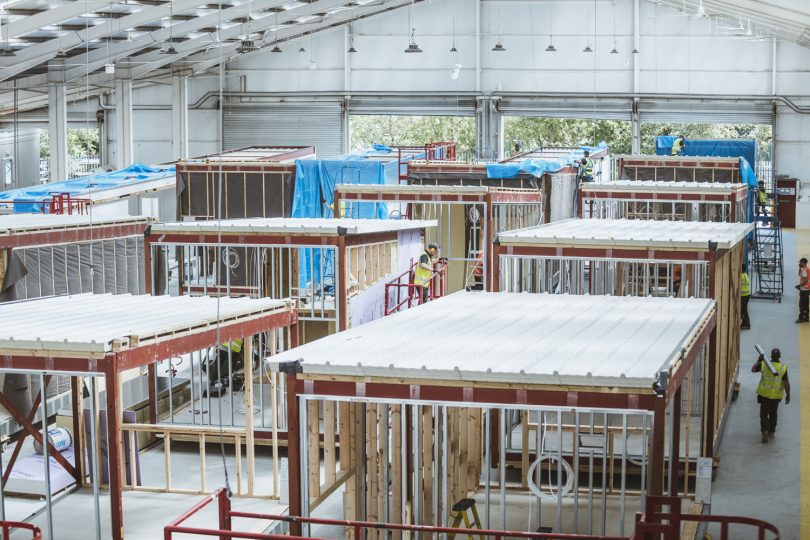
When buildings are built offsite using lean manufacturing, you drastically reduce its carbon footprint. Modular buildings use less total energy and waste both in their construction and installation as well as being more cost-effective.
Lean manufacturing continually drives every process to improve your product quality and efficiency so boosts sustainability.
Modular buildings are also recyclable and reusable by design which massively reduces the amount of energy needed to construct future buildings.
Offsite construction has been around for over 50 years but, as a country, we’ve been slow to adopt it. Across the industry, we all knew we’d have to change the way we build one day. There’s simply not enough planet to carry on as we have for centuries. It’s good that the climate change emergency has brought that into sharp focus so hopefully this time it will be a change for good.
For more information, visit Net Zero Buildings or get in touch on 01638 596 155.