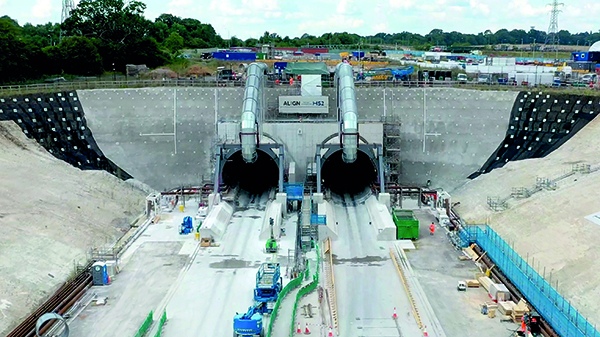

HS2 – Chiltern Tunnels and Colne Valley Viaduct
In the beginning project proposal of an expansion of this railway between London and Birmingham, the extensive network will include a 3.4km long viaduct over Colne Valley, and the 15.8km bored Chiltern tunnel, consisting over four vent shafts, and one intervention shaft. High Speed 2’s main work contractors for this job are Align JV, with around 1,200 people set to be working on the design and construction of the £965 million project at its peak.
Colne Valley Viaduct
Supported by 56 piers and 292 underground piles, the Colne Valley Viaduct will be the UK’s longest railway bridge and able to withstand trains travelling up to an incredulous 200mph. The viaduct will be held around 10m above the surface of the four lakes it crosses in the valley: Korda Lake, Harefield No. 2 Lake, Savay Lake, and Broadwater Lake.
The aesthetic design inspired by “flight of a stone skipping across water,” has been configured to have wider spans in the construction where the bridge crosses the lakes, and narrower spans where it approaches. This immense architecture was chosen in order to minimise the footprint the viaduct has on the Colne Valley lakes and compliment the natural surroundings of greenery. Aware of its impact on the nature of the valley, those involved with the HS2 project have worked closely with both Affinity Water and Environment Agency to prioritise the protection of the affected environment, with constant monitoring done on the project by specialist engineers. A webinar was held in June 2021, hosted by Align and HS2, to address the input by the Environment Agency, and answer frequently asked questions regarding how the viaduct is built, and the ongoing checks and HS2 laws in place to protect the environment and the purity of the water supply in the area.
On the 31st May, HS2 Ltd announced the start of construction on the railway’s first and longest viaduct with the launch of an enormous 700 tonne bridge-building machine at an event attended by the HS2 Minister, Andrew Stephenson MP, just outside London.
Stretching for more than two miles (3.4km) across a series of lakes and waterways between Hillingdon and the M25, the Colne Valley Viaduct will also be the longest railway bridge in the UK.
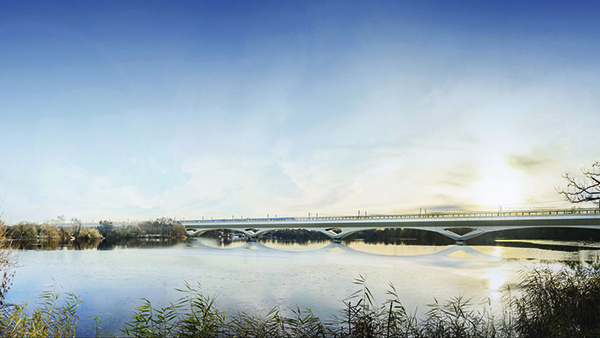
Colne Valley Viaduct concepts created for HS2 by Grimshaw Architects
At the launch event HS2 Minister, Andrew Stephenson said:
“Today, HS2 began construction on what’s set to be Britain’s longest railway viaduct, a landmark moment for HS2 and a feat of British engineering, taking the HS2 line from London, and into Hertfordshire and Buckinghamshire.
“Infrastructure is the backbone of HS2 and this viaduct will be integral to delivering faster journeys and an increased capacity rail network.”
Welcoming the milestone, HS2 Ltd Chief Executive Mark Thurston said:
“I’m absolutely delighted that we have started work to assemble the giant deck segments that will form the Colne Valley Viaduct. It is yet another big milestone for HS2 Ltd, as we work to deliver the UK’s new high speed railway. Once complete, this record-breaking structure will form a key part of the HS2 railway – helping to deliver better connections across the UK, free up rail capacity on the train network, and offer passengers a zero carbon travel option.
“I’d like to thank all those involved in getting us to this exciting stage and look forward to seeing the whole viaduct come together over the coming years.”
Chiltern Tunnels
At the longest tunnel on the HS2 route between London and the West Midlands, the Chiltern Tunnel is a twin-bore tunnel that launched in the summer of 2021 and is set to carry passengers under the Chiltern Hills. In housing the HS2 railway beneath the ground, the project intends to safeguard the nature and habitats from the hills and significantly reduce disruption to the local area.
Florence and Cecilia, launched in May and July respectively, are the two, 2000 tonne tunnel boring machines that have been put in place. As HS2’s first pair of tunnelling machines, they will be working nonstop underground for the next three years at a current average speed of 15m per day. The monstrous machines can be tracked online in order to watch their progress beneath the glorious hills of Buckinghamshire.
“I look forward to working with the team to deliver what will be two of the most exciting and ambiguous engineering challenges on the project,” remarks David Bennett, the Delivery Director of HS2.