
The Mayan Train
The Mayan Train (also known as Tren Maya or Maya Train) is a 1,525km intercity railway in Mexico that will traverse the Yucatán Peninsula. Construction began in June 2020 and is scheduled to be completed by 2024. The railway begins in Palenque in Chiapas and travels northeast towards Cancún in Quintan Roo via two routes that encircle the peninsula. The project aims to connect tourist destinations in the Caribbean with lesser-known sites inland, including the historic Mayan sites from which it derives its name.
The route of the Mayan Train consists of seven sections. Section one runes from Palenque to Escácrega; section two from Escácrega to Calkini; section three from Calkini to Izamai; section four from Izamai to Cancún; section five from Cancún to Tulum; section six from Tulum to Bacalar and section seven from Bacalar to Escácrega.
The first section of the Mayan Train will start operating in December 2023, transporting both residents and tourists. The train will travel 1,525km, connecting the states of Chiapas, Tabasco, Campeche, Yucatán, and Quintana Roo.
In May 2021, the consortium made up of Bombardier Transportation Mexico, Alstom Transport Mexico, Gami Ingeniería e Instalaciones and Construcciones Urales Procesos Industriales won the international public tender for the one-billion-euro contract, issued by the National Fund for the Promotion of Tourism (Fonatur), the government agency responsible for the Mayan Train. The contract encompasses the design, manufacture, and delivery of 42 X’trapolisTM trains, the railway systems, workshops, and garages that will be part of the Mexican government’s emblematic project.
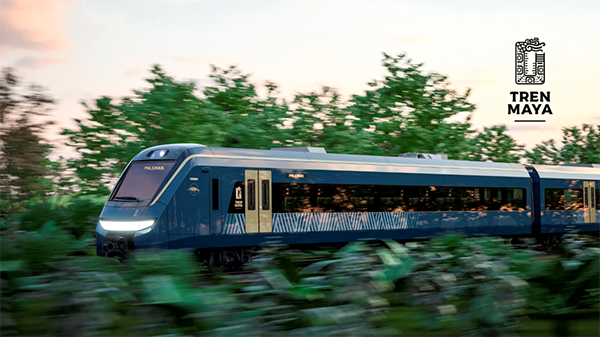
The X’trapolisTM is Alstom’s electric train that will have a unique and exclusive design for Mexico. It is an updated, competitive, and long-term reliable train, based on trains that have already proven their worth. Its exterior design is inspired by the Mayan culture, in the majesty of the jaguar, as an endemic element of the region, in its elegance, speed and beauty. The 42 trains to be manufactured by Alstom will reflect the varied colors and textures of regional art.
The Mayan Train will have three types of trains:
- Xiinbal (walking): standard regular service train that will allow passengers to enjoy a journey with large panoramic windows.
- Janal (eating): a restaurant car, with a design inspired by the work of engineer and architect Luis Barragán; it has comfortable spaces designed to enjoy regional cuisine.
- P’atal (staying): train for long distances, with comfortable cabins, day, and night, that will make the trips a unique experience.
The interior design is inspired by a range of shades of blue, characteristic of the sea that surrounds the region and different organic forms. This concept combines a range of varied colors that pay tribute to modernity and tradition, as well as the beautiful landscape of the Mexican southeast. When entering the common areas, such as lobbies and cafeteria, a mix of hues is used to give a feeling of welcome and warmth. The result of all these combinations is a contemporary train with a strong identity.
All three versions of the X’trapolisTM offer ample seating and luggage space, as well as vertical shelves on each carriage and upper shelves taken from Alstom’s CoradiaTM. Since the floor is completely flat, passengers with reduced mobility will have complete freedom of movement.
This train will also use components and know-how contributed by the old Bombardier, the highlight being its lightweight Flexx Eco bogie, designed for a top speed of 176 km/h.
The Mayan Train will be one of the most important infrastructure works in the history of Mexico’s rail network and a unique opportunity to boost economic growth in the southeast region. The Mayan Train is a project to improve people’s quality of life, take care of the environment and trigger sustainable development.

Tenosique, TabascoMexico, January 22, 2023.- Construction work for the Mayan Train on the “Boca del Cerro” bridge, over the “Usumacinta River Canyon”, in southeastern Mexico.