
Ciaràn Cotter, Technical Director at Solivus explains why diesel-free off-grid power supply marks an important next step in the journey to a sustainable rail future.
It’s easy to see why rail electrification will play such an important role in net zero targets. Electrical traction is, after all, not only an environmentally friendly, pollution-free and energy efficient mode of transport but it can be powered by renewable energy sources.
But it isn’t just about ensuring a sustainable alternative to diesel traction. There are a host of other innovative, future-focused ways that rail professionals can transition to green energy sources and negate fossil fuel reliance.
Take, for example, diesel generators. Traditionally, large-scale rail construction has relied on diesel generators to provide the reliable off-grid power needed to support rail renewal work. However, while their advantages in terms of power, performance and portability cannot be argued, they do come with some major environmental drawbacks. Principally, they emit large amounts of harmful pollutants which can impact the global climate.
Thus, in light of government policies and regulations on greenhouse gas emissions and the underpinnings of the Paris Agreement, it was clearly only a matter of time before diesel generator use came under closer scrutiny.
Of course, this was seen in April 2022 when it became illegal to use red diesel in cranes, bulldozers, or for powering mobile generators on construction sites. Then last year we saw the Construction Leadership Council set out plans for the industry’s best-performing contractors to ban the use of diesel generators on sites by 2025.
Enjoying this article? Sign up for our FREE newsletter!
Clearly then, the days of diesel generators are numbered – but what’s the alternative?
Destination diesel-reducing
At one point, it might have appeared that there is no obvious, cost-effective solution which can scale to deliver the same level of reliability and performance as a diesel generator. Yes, there have long been renewable options, but they have traditionally been costly, and installation and maintenance has been expensive. In addition, when it comes to solar, a major prohibitive has been the associated weight of standard rigid panels, making them unviable for the temporary structures, such as cabins, used on construction sites.
However, the good news is that there is now a much more flexible, cost-effective and high-performance alternative.
Enter the latest generation of lightweight commercial solar. Thanks to advances in technology, the latest generation of innovative lightweight solar panels are a fraction of the weight of conventional panels and have more universal applications for fixing methods which have opened up new roof space opportunities.
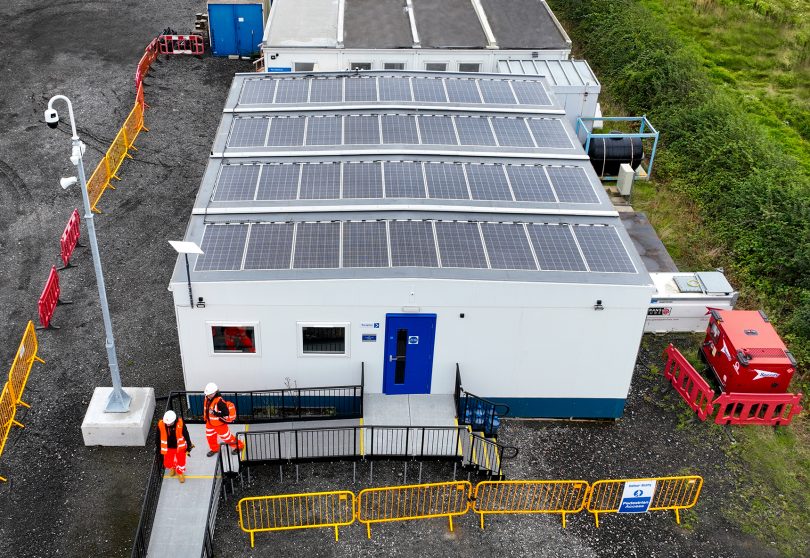
A great example of this opportunity can be found in Solivus’ recent work with one of the world’s biggest infrastructure names. Hereby, the challenge was to create a solar-fuelled alternative to the diesel generators currently used to power our client’s construction site cabins portfolio.
To achieve this, Solivus created an innovative, low carbon set up which combines lightweight solar panels with a battery storage system and a backup diesel generator. An off-grid, decentralised, self-sufficient energy hub. The system works by storing the excess energy generated by the solar panels in a connected battery storage unit. As a result, site cabins can be powered continuously, with the system automatically releasing the reserve energy even when there is no sunlight.
The recent pilot project – a modular building with a roof space of approximately 100m2 – is estimated to have saved our client up to 14,416 Kg of carbon dioxide emissions, 5223 litres of diesel with a gross annual saving of £9,140, while ensuring a reliable, resilient, clean energy supply. This is a solution they now plan to roll out to their clients.
Underscoring this too is a dedicated operations and maintenance (O&M) programme designed to ensure the project continues to reach its full value potential. This is supported with a five-year workmanship warranty, a twelve-year product warranty and a twenty-five-year performance warranty.
This offers a huge opportunity for emissions-reductions in rail construction works, especially as Network Rail works towards its target to reduce non-traction energy consumption by almost 20% and carbon emissions by 25% by 2024.2
Making headway
There is no doubt that the future will see rail evolve to become the gold standard of low carbon transport and a central player in the transition to a sustainable mobility future. But achieving this will require sustainable focus in every aspect of rail operations, on and off track. Thus, the recommendation is for rail professionals to seize the green off-grid power opportunity now and, in turn, make even greater headway in their own sustainable journey.
For more information on Solivus’ Modular Buildings Solar System with a leading infrastructure giant visit: https://www.solivus.com/news/solivus-helps-ditch-the-diesel-with-modular-building-solar-system. Alternatively, visit www.solivus.com
2 https://www.networkrail.co.uk/stories/six-times-we-went-green-on-the-railway/