
Küstrin Rail Bridge
In August 2024, the first trains crossed the new Küstrin Rail Bridge – the world’s first to use carbon hangers.
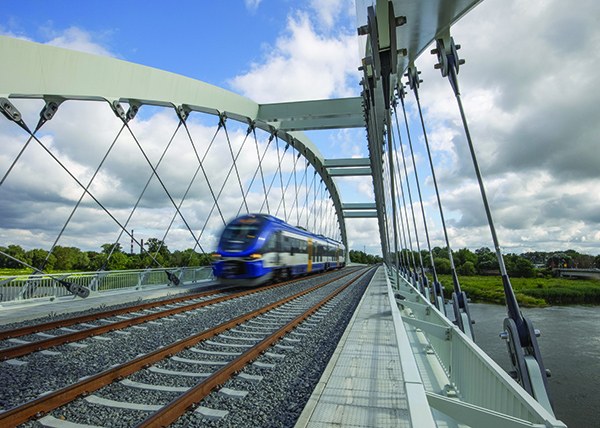
In a festive ceremony to inaugurate the new Oder bridge near Küstrin-Kietz, Germany, invited guests were Michael Theurer, Federal Commissioner for Rail Transport in Germany and Poland, Piotr Malepszak, Undersecretary of State in the Ministry of Infrastructure in Poland, and Dr. Dietmar Woidke, Prime Minister of the State of Brandenburg, who celebrated the structure as a symbol of European cooperation between the two countries. The innovative network arch bridge features a special engineering solution developed by schlaich bergermann partner (sbp): a lightweight and material-saving hanger net using carbon tensile elements.
The design concept for the new replacement bridge emerged from a two-stage international design competition, which Schüßler-Plan and Knight Architects won. The project comprises two slender and elegant bridge structures. The 266m-long main crossing replaces a derelict, 1926 single-track truss with a distinctive 130m network arch spanning the Oder River. With its crown positioned above the demarcation line of the border, the steel structure acts as a landmark that highlights the importance of the location and welcomes travellers between the two countries. The result is a filigree network arch which blends seamlessly into the continuous three-span eastern approach on the Polish side. The less dramatic, but equally important, 176m Odervorflut bridge crosses a flood relief canal 500m west of the main crossing and is designed with similar architectural features to the main bridge. Part of the overall project is also the renewal of the track system in a section of 1,250m in length.
The project’s general planning services were provided by Schüßler-Plan with Knight Architects overseeing the architectural concept development throughout developed design and planning application. sbp developed the structural design of the network arch bridge, that followed the competition-winning concept, but instead of the originally proposed flat bar steel hangers, carbon cables with a diameter of 50mm were utilized. This significantly reduced the weight of the structure and cut the amount of steel and concrete used in the deck. The structure is the world’s first and so far, only rail bridge using the high-performance material carbon for significant load-bearing elements. The technical basics for the feasibility of this solution had to be established within the framework of a comprehensive expert procedure, accompanied by specialists, to obtain special approval and highlight the commitment to technical innovation.
The crossing will help to increase line capacity and shorten travel times by allowing a maximum permissible speed of 120km/h, enabling the revival of rail travel both regionally and internationally. In the long term, this will help reduce road traffic and contribute to the mobility shift towards more sustainable means of transportation.
Andreas Keil, Board Member of sbp SE, emphasized: “We are proud that we were able to convince the client of our alternative technical solution of a network arch with carbon hangers. As such, the Oder Bridge symbolizes a striking example of innovative engineering and marks a new chapter in bridge construction.”
It is the second bridge structure by sbp that uses carbon hangers for the superstructure. Already on the Stuttgart light rail bridge, which was awarded the German Engineering Prize, carbon hangers were used.
“It has been a journey from a good idea to a bold decision to a new type of structural system. I am particularly pleased that initial doubts turned into valued cooperation with many parties involved in this project,” summarised Lorenz Haspel, Director of Research and Development at sbp.
André Hörmeyer, Managing Director of Schüßler-Plan Ingenieurgesellschaft in Berlin, added: “The inauguration of the rail bridges over the Oder River and the Odervorflut marks the completion of a technically outstanding and complex project. Thanks to the impressive teamwork of all those involved and the excellent cross-border cooperation, this challenging project could be realized. We are proud to have accompanied this impressive project throughout its entire duration, from the competition to its successful completion.
Bart Halaczek, Director at Knight Architects and Project Lead for the Küstrin bridges, said: “The Küstrin-Kietz Rail Crossing will play a crucial role in improving the transport links between Poland and Germany. Our concept provided a simple, clear and elegant design solution that distilled the complexity of a large railway development project to a single object with powerful, symbolic meaning and we welcome the tenacity with which the client and engineers retained the original design intent. The use of carbon fibres in the load bearing structure is a world first and demonstrates how great design and innovation can go hand in hand to deliver beautiful structures that connect people and enrich communities.”