
Porto Metro Yellow Line Extension
In June 2024, leaders in transportation infrastructure and sustainable engineering solutions Ferrovial celebrated the opening of Porto’s Oporto Metro Yellow Line extension.
Built in a joint venture with Portuguese construction company Alberto Couto Alves, the project, with a budget of €99 million, is reported to have generated an average of 284 direct jobs during the 36-month construction period.
During this time, a new 3.15-kilometer section of light metro was added to extend the Yellow line from Santo Ovídio station to the south of the city, serving the districts of Vila Nova de Gaia, Mafamude e Vilar do Paraiso, Oliveira do Douro, and Vilar do Andorinho. The project also included the construction of a viaduct, a 770-meter tunnel, and three new stations, meaning that the city is now more connected than ever before.
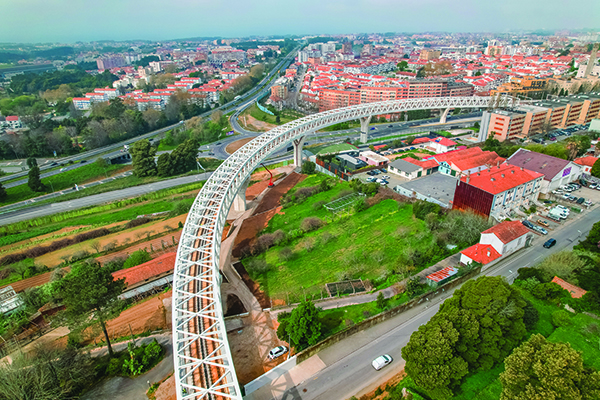
One of the most complex parts of the project was the construction of the viaduct between Santo Ovídio and Manuel Leão stations. The metal latticework structure sits on piers up to 22 meters high and traces a curve 420 meters long. It was decided that erecting the structure from the ground with cranes would be too difficult, so instead the 2,746-ton structure was slid into place from one end. The viaduct’s assembly took 143 days of working around the clock, with a team of 77 people coming together in order to get the viaduct in place.
Ferrovial’s participation in this subway extension, which began in 2021, reaffirms the company’s contribution to transforming Portugal’s infrastructure. Ferrovial has been operating in Portugal for over three decades, having participated in landmark projects such as the construction of the Linea Norte railway line connecting Lisbon with Porto, Lisbon Metro’s Blue Line, the Via do Infante highway in the Algarve, the Daivões dam, and the Gouvães hydroelectric power plant.
The Yellow Line extension was opened with a special ceremony, attended by Miguel Pinto Luz, Portugal’s Minister of Infrastructure, and Maria da Graça Carvalho, Minister of Environment and Energy, accompanied by Juan Magín Lozano Villalta, Ferrovial Construction’s Head of Civil Engineering for Iberia and LatAm.