
Brenner Base Tunnel
The Brenner Base Tunnel (BBT) is a straight, flat railway tunnel connecting two countries. It runs for 55 km between Innsbruck (in Austria) and Fortezza (in Italy).
In May 1994, a railway bypass was opened south of Innsbruck, known as the Inn valley tunnel. This 12.7 km tunnel links to the Brenner Base Tunnel. Passenger and freight trains along this stretch will therefore not only travel through the Brenner Base Tunnel, but for a few kilometres, through the Inn valley tunnel as well. This line, totalling 64 kilometres, will become the longest underground railway connection in the world.
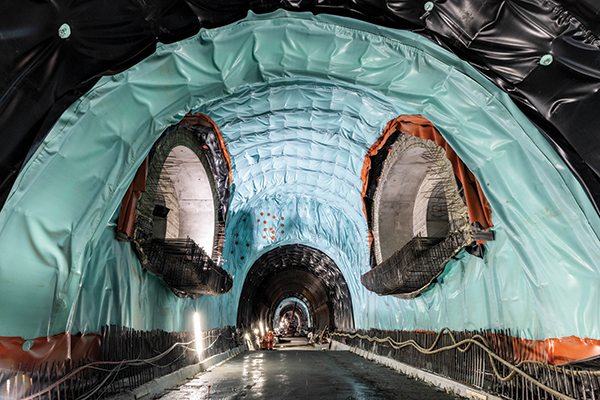
The BBT consists of two tubes, each 8.1 m wide, running 40-70 m apart from one another. These tubes are each equipped with a single track, meaning that train traffic through the tubes is one-way. The two tubes are linked every 333 m by connecting side tunnels. These can be used in emergencies as escape routes. This configuration conforms to the highest security standards for tunnels.
A peculiar feature of the Brenner Base Tunnel (BBT) is the exploratory tunnel running from one end to the other. This tunnel lies between the two main tunnels and about 12 m below them and with a diameter of 5 m is noticeably smaller than the main tubes. The exploratory tunnel will be essential for drainage when the BBT becomes operational.
The BBT runs for 64 km between Tulfes/Innsbruck and Fortezza, making it the longest underground railway stretch in the word. The BBT ends in Innsbruck in the existing railway bypass tunnel, which ends in Tulfes. A new rescue tunnel is being built running parallel to the bypass. The two-tube tunnel system between Innsbruck and Fortezza is 55 km long.
Tunnel Boring Machine Update
Starting in September 2024, and working in the Austrian project area, Tunnel Boring Machines (TBMs) “Wilma” and “Olga” will drive around 7.5 kilometres of the two main tunnels northwards.
The Wilma and Olga TBMs are the last two of the nine tunnel boring machines to be used in the construction of the Brenner Base Tunnel. Wilma will excavate the west tunnel of the Brenner Base Tunnel northwards, while her “twin sister” Olga will drive the east tunnel in the same direction.
Both tunnelling machines will excavate around 7.5 km in the direction of Innsbruck. Towards the south, at HS3 Pfons-Brenner, drill&blast tunnelling using the NATM method (New Austrian Tunnelling Method NÖT) will be used.
Sill Gorge
The “Sill Gorge” construction lot, which includes the northern portal of what will be the longest railway tunnel in the world, is now officially finished.
Despite the fact that the stretch between the BBT’s northern end and the main station in Innsbruck is comparatively short (only 600 metres), the work required some highly challenging engineering. For example, it was necessary to insert up to 60 anchor bolts, each 120 metres long, into the loose rock of the Viller Berg slopes at the northern portal.
The works were completed within the expected 52-month timeline. The contract was worth 60 million Euro and the construction work was carried out by PORR Bau GmbH of Kematen.
The re-vegetation work meant to restore the construction site to its original state is currently ongoing. This is a very popular recreational area for the residents of Innsbruck; starting in spring 2025, they will once again have access to the two stretches of the hiking loop that run through the gorge.
H41 Sill Gorge-Pfons
After 2024 was marked by significant milestones, 2025 begins with a new challenge for the H41 Sill Gorge-Pfons construction site, the northernmost active construction lot of the BBT project.
The two TBMs working on the H41 Sill Gorge-Pfons site, Lilia and Ida, each completed 5 km of excavation in 2024 and are now less than 3 km away from their final destination in the municipality of Navis. This remarkable progress, which began in May and June 2023 respectively, might suggest that their path has been straightforward, but that is far from the case. The achievements of the past year and a half are all the more remarkable given the challenges that have been overcome. The route for both TBMs has been, and will continue to be, very demanding. Both TBMs have already crossed two major fault zones, named “Viggartal” and “Walzn.”
TBM Ida, which is currently working on the main west tunnel, faces a new challenge: the “Werner” fault zone, located below the Arztal valley in the town of Pfons.
TBM Lilia will encounter a similar section in the eastern main tunnel. Crossing the fault zone will require a reduction in speed to allow the necessary consolidation work to be carried out safely.
Meanwhile, the final concrete lining work continues in the completed tunnel sections, with about a quarter of the planned lining in the main tunnels northwards already completed.