
HS2 Long Itchington to Delta Junction
The southern section of the new high-speed railway in Warwickshire features two viaducts near Radbourne before passing Southam and entering a tunnel beneath Long Itchington Wood.
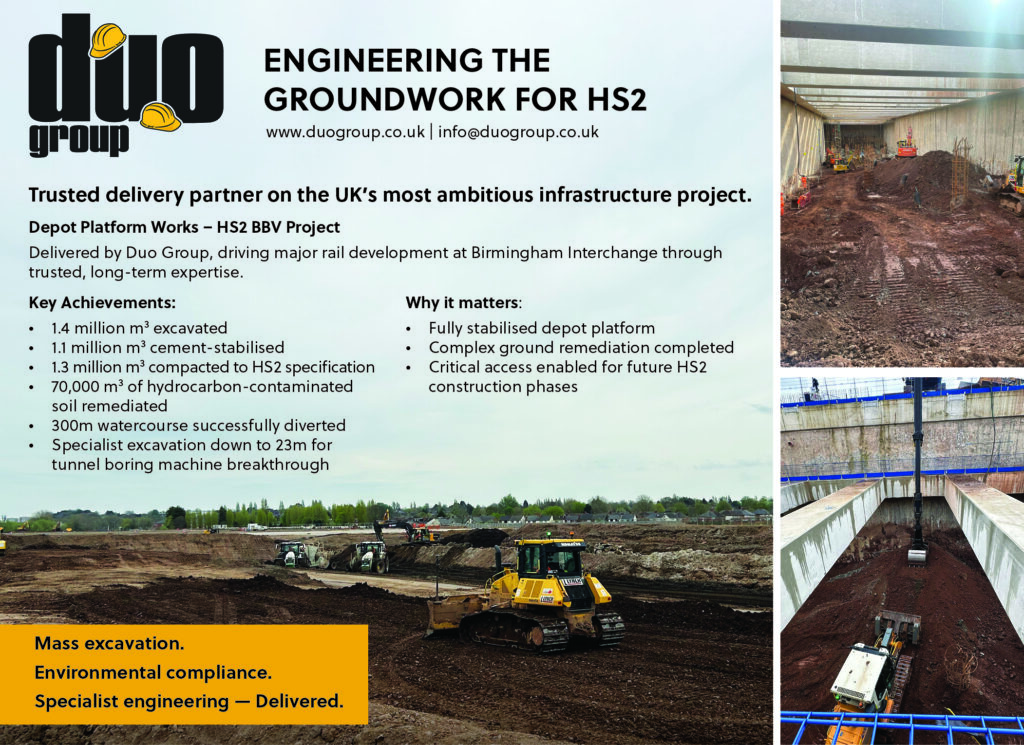
The new high-speed rail network then crosses the River Itchen and the Oxford Canal before heading northwest past Bascote Heath, Offchurch, and Cubbington. A ‘green tunnel’ at Burton Green reduces the railway’s impact before it moves towards Interchange Station in Solihull.
Further north, the new high-speed rail network crosses the M6 and M42, entering the ‘Delta Junction’ near Water Orton. This triangular junction allows trains to travel between London, Birmingham, and the North.
Long Itchington Wood Tunnel
The Long Itchington Wood Tunnel is a 1-mile (1.6km) twin-bore tunnel running beneath ancient woodland in Warwickshire. TBM Dorothy was launched in December 2021 and completed both bores of the tunnel by March 2023.
Long Itchington Wood and neighbouring Ufton Wood form a continuous block of ancient woodland, dating back to at least 1600 AD. Designated as a Site of Special Scientific Interest, they support complex ecosystems that have evolved over centuries. The Long Itchington Wood Tunnel, running beneath the woodland, is a key element of HS2’s environmental strategy to preserve and protect this vital natural habitat.
Tunnel construction
TBM Dorothy is 125 metres long and started her journey at the tunnel’s north portal in December 2021, breaking through into the south portal in July 2022. She was then relaunched in November 2022 and completed her second bore in just four months – making Long Itchington Wood Tunnel the first HS2 twin bore tunnel to be completed.
After TBM Dorothy’s first breakthrough in July 2022 the machine was taken apart and brought back to the tunnel’s north portal to start the second drive. The gantries were brought back through the tunnel while the huge cutterhead, weighing 160 tonnes and with a 10-metre diameter, was moved by road during an intricate night-time operation. The 130-tonne tail skin and eight other large pieces from the TBM’s front and middle shields were also transported by specialist equipment.
The tunnel is the first deep tunnel on the high-speed route to complete its civil engineering phase. It comes before the internal fitting out of the tunnel with the complex systems needed to operate the high-speed line including the power, track and signalling.
The complex process to fully excavate two tunnel drives and the entrance sections produced around 750,000 tonnes of material, which has since been reused to build embankments along the route of the railway.

Delta Junction
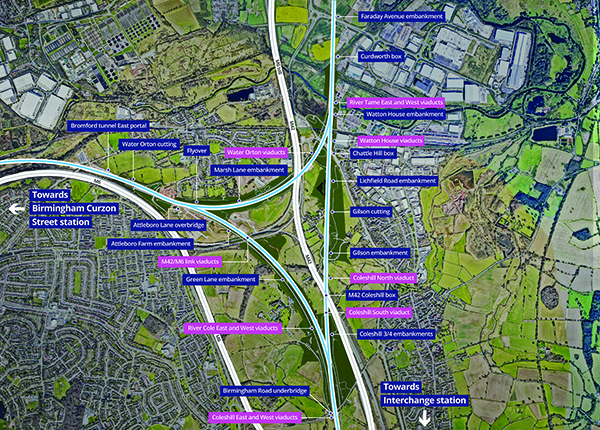
HS2’s Delta Junction is a triangular section of line, enabling trains to travel between London and Birmingham, Birmingham and Manchester, and direct between London and Manchester without stopping at Birmingham.
It is made up of embankments, cuttings and a total of 13 viaducts taking high speed tracks over motorways, local roads, existing rail lines, rivers and floodplains. The viaducts include 6 precast segmental viaducts, 4 composite viaducts and 3 low viaducts.
Precast segmental viaducts (PSV)
Segmental viaducts have standard spans of 45 metres with decks built off concrete precast segments which are prefabricated at HS2’s Kingsbury Precast Yard at Lea Marston. The 6 precast segmental viaducts are:
- River Tame East and West
- Water Orton 1 and 2
- Coleshill East and West
Around 3,000 deck segments for the Delta Junction are being produced at HS2’s nearby purpose-built factory near Lea Marston. The segments and other materials are transported to site using haul roads to reduce HS2’s impacts on local roads.
Composite viaducts
Composite viaducts have standard spans of more than 45 metres with their decks built off weathered steel boxes or beams, with a concrete deck on top. The four composite viaducts are:
- M42/M6 Link Road East and West
- River Cole East and West.
The M42/M6 link viaducts – the two parallel viaducts that cross these roads – were the first Delta Junction structures to be installed, with the final of four viaduct deck pushes completed in September 2024.
Low viaducts
Low viaducts have standard spans of 25 metres with their decks built off standard concrete precast beams, with a concrete deck on top. The 3 low viaducts are:
- M42 Coleshill North and South
- Watton House.
HS2’s landscape architects and engineers from Systra and Mott MacDonald, working closely with architects Weston Williamson + Partners, have developed plans for connected and accessible areas that will include tree planting and new wildlife habitats around the Delta Junction viaducts.
The goal for the landscape design is to tie the viaduct structures into the local landscape and create opportunities to enhance it. This includes improved connections through the Delta Junction area, which will be developed with new paths and cycle routes set within a nature rich corridor.